




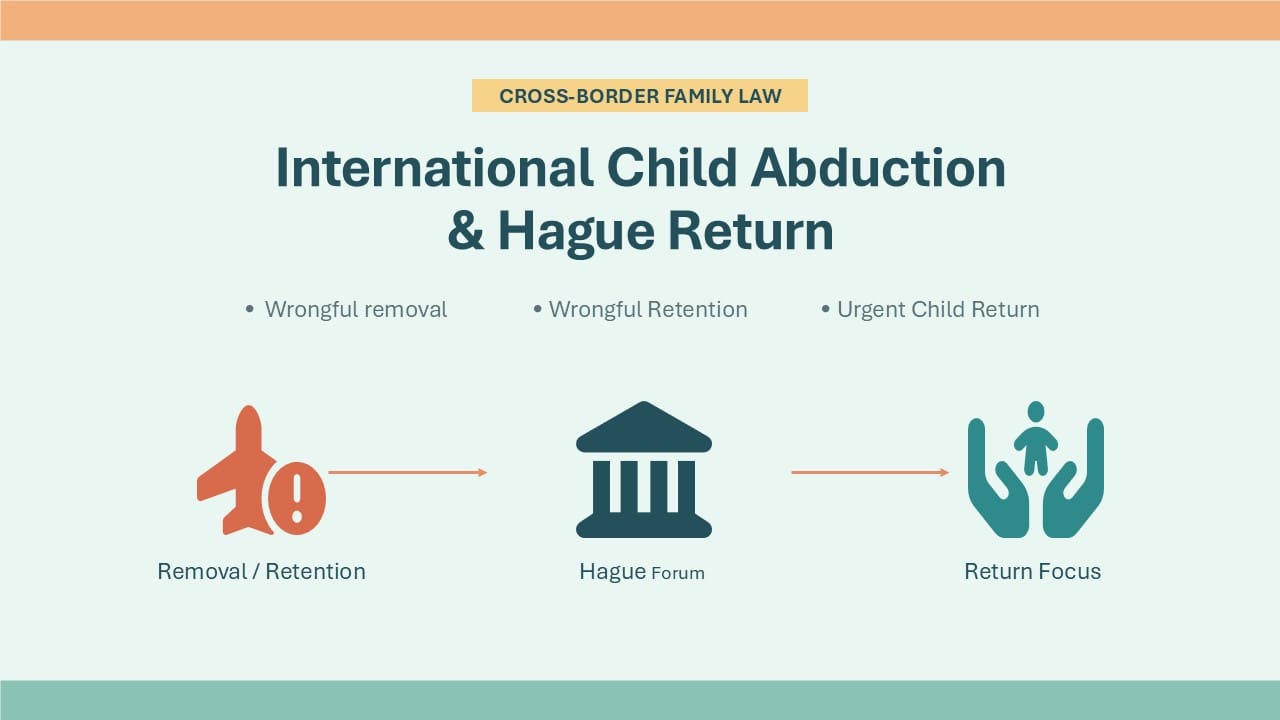
When it comes to cases of parental abduction of minor children, every detail about the case should be taken into account. The location of the child, his or her residency prior to the removal from the house, custody rights, travel, and any court actions should be considered when creating the legal strategy to recover the abducted child. Failure to implement an action plan may hinder evidence gathering or lead to contradicting results in various states.
Vera Zambrano and her associates provide consultation and legal representation in international child custody cases, child abduction cases, Hague Convention procedures, and urgent family law cases in Germany. This law firm specializes in international family law, transnational litigation, and cases in which several jurisdictions are involved.
International Child Abduction Under German Family Law
International family law makes a distinction between child abduction by wrongful removal and child abduction by wrongful retention. A child is wrongfully removed when that child is taken from her or his habitual residence country in violation of already existing custody rights. A case of wrongful retention normally begins with a legally permitted trip abroad but becomes illegal when the child is not returned as per the initial agreement.
Terms like “child abduction,” “child removal,” “parental kidnapping,” or “illegal child retention” are often used to refer to the same type of situations. Legally, however, it is not the label that counts but rather the matters of fact. The basic questions often concern who was entitled to make a decision as to where the child was to live and whether the entitled party had been exercising that right, plus where the child had its habitual residence before being taken or retained abroad.
People often seek information on what happens when a parent takes their child out of the country without her father’s consent. However, the same legal principles would be relevant if the required consent of the mother is missing. Gender thus does not count as a criterion. The key issue is who has custody rights or the right to determine the place of residence of the child and whether any consent, court ruling, or binding agreement has been in place.
The Hague Convention on International Child Abduction
The Hague Convention concerning the Civil Aspects of International Abduction of Children, signed on October 25, 1980, is widely referred to as the Hague Abduction Convention or the 1980 Hague Convention. The Convention itself does not actually render a decision regarding custody. Rather, it lays out the procedure for returning a child back promptly to the country where that child is habitually residing so that the long-term custody questions can be resolved there. The Hague Order does not determine any custody case either.
The Hague Convention applies only to those children who are below the age of 16. Also, one of the necessary requirements for the application of the Convention is that it must be in force between the countries involved in the particular situation. Just finding a list of Hague countries may not be enough. If one of the countries became a member of the Convention later, it is also necessary to check if such accession has been accepted by Germany.
Germany ratified this Convention, which came into effect in Germany on December 1, 1990. Custody rights can arise either automatically by virtue of legislation, a court or administrative decision, or as a result of a binding contract between parents.
Requirements for a Hague Child Return
The application for urgent return of a child will require examining facts and relevant international child custody regulations. The most important requirements for the application generally include the following:
- The child habitually resided in a Hague Convention state at the moment of unlawful removal or detention.
- The unlawful removal or detention is contrary to the child’s custody rights.
- The custody rights are being enforced or would be enforced but for the unlawful removal or detention.
- The child has not attained the age of 16.
- The Convention is applicable between Germany and the state of removal.
- The application for return is lodged with an appropriate central authority, court, or administrative authority.
These specifications primarily arise from Articles 3, 4, 5, and 8 of the Hague recommendation. A return application must specify who the child is and who the parties involved in the application are and must state what the legal and factual basis is for seeking the return and any other information available regarding the child’s whereabouts. It may also include pertinent decisions regarding custody, international agreements regarding custody, and other substantiating documents.
A Hague return case shall not be regarded as a custody battle. The court usually will not consider and determine which of the parents is able to provide for the child better in the long run. Its primary task is to determine whether the child was removed or kept from court without lawful reasons and whether the exceptions mentioned in the Hague recommendations are applicable.
An important thing is timing. If you file a petition for return within a year of a wrongful removal or retention, the Hague Convention says that the child should be returned as soon as possible. You can file a Hague petition after the year has expired, but then the authorities might take into account whether the child has become settled in his or her new surroundings.
Habitual Residence and the Child’s Center of Life
Habitual residence is a very important concept in international child abduction cases. Habitual residence does not always coincide with such terms as nationality, official registration, legal domicile, place of birth, or any address shown in documents. The difference between domicile and habitual residence becomes especially relevant for international families that travel between the countries, where the child spends part of the year.
While deciding whether the child is habitually resident in that country, the court will look at his or her actual social and family environment. The main indicators might include the duration and the stability of the child’s residence at a certain place, school or daycare attendance, medical help, language, relationships with family and friends, free time activities, and the parents’ plans for the child.
There is no universal 6-month or 183-day rule establishing habitual residence in international child custody cases. Each case must be assessed on its own merits. In the case of babies and very young children, the family and caregiving situation is much more important than in the case of older children who go to school and have already formed social connections.
Habitual residence will change if it is determined that the child has developed a stable center of life in another country. However, the change doesn’t occur simply by registering a different address, getting immigration papers, or organizing a different living arrangement without the consent of the other parent. This issue is frequently a source of the greatest number of controversies in Hague Convention child abduction cases.
Hague Child Abduction Proceedings in Germany
The procedure involves starting with clear, organized timelines outlining the custody agreement, the last habitual residence of the child, the time of removal or retention, agreements of parents, and the current residence of the child. The lawyer specializing in international abduction must determine which laws and legal agreements apply in the particular situation.
In Germany, the processing of return applications can be done through the Central Authority or, depending on the particular case, submitted in the relevant court or authority in the location where the child is located. The German Federal Office of Justice operates as the Central Authority for Hague Convention custody cases and oversees the processing and forwarding of requests and cooperation of the Central Authority of other signatory states.
In cases of child transportation to Germany from abroad, decision-making on the return applications is done by one of the family courts of Germany that specializes in that area. Not all family courts in Germany process Hague Convention abduction cases, and only a small subset do so among the nearly 600 available courts.
Among the jurisdiction of the Berlin Higher Regional Court lies the Pankow Family Court, which specializes in the handling of requests for the return of children illegally taken to or kept in Berlin.
It is important that the court take action promptly. According to Article 11 of the Hague Convention, if there is no verdict after the end of the sixth week from the start of the proceedings, either the applicant or the Central Authority can request an explanation about the delay. Of course, it does not mean that every case will need exactly six weeks to finish, but it is evident that Hague child return processes shall be executed in a timely way.
While the return case is being processed, one may need to take temporary protective measures. The court may take actions in accordance with the circumstances, such as keeping the child in one place, preventing the child from leaving internationally, requiring documents to be confiscated for travel purposes, or regulating which party has the right to make decisions about the place of residence of the child temporarily.
Any Hague Convention kidnaping case should be coordinated with the emergency application in the German family court. It is vital to ensure that the protective measures requested, the facts stated, and the evidence submitted all aim at achieving the one and the same goal.
Child Return Proceedings Within the European Union
The international child abduction that occurs between Germany and an EU member state is governed by the Hague Convention and EU Regulation (2019/1111), otherwise referred to as the Brussels IIb Regulation. This regulation addresses the issues of jurisdiction, responsibility for parental care, recognition and enforcement of judgments, and child abduction cases. While the basic principles when returning abducted children are taken from the Hague Convention, additional regulations are included by the EU.
The Brussels Regulation is implemented in the countries that are EU members, excluding Denmark. Denmark does not need to comply with the Brussels Regulation, but in some cases the Hague Convention may still be applicable to cases between Denmark and Germany. Thus, it is important to determine the legislation applicable in each particular case instead of assuming that all the international disputes in Europe are governed by the same laws.
A lawyer specializing in international child custody cases may need to organize matters such as jurisdiction specifics, current judicial affairs, parental responsibility, acknowledging the custody order, effectuating decisions, and inter-court communication in Europe. The court handling the matter of the Hague return request is not always the one to make the ultimate decision concerning custody.
Defenses and Exceptions Under Article 13
There are not many situations when the court may deny the application. The defenses the court may find useful include evidence of lack of exercise of parental rights by the other parent, their consent or acceptance of the child’s removal from the country, as well as fact that the return of the child may place them at risk of physical or mental harm or put them in an unacceptable situation.
In addition, the court may also take into account the wishes of the child if the child concerned is mature enough to have opinions. However, the court has to analyze what kind of opinion is expressed by the child and whether it is formed independently from parental pressure or parental conflict and loyalty.
The use of the grave-risk defense as per Article 13(1)(b) needs to put focus on the details of the situation. It is not enough to discourage return just on the basis of the threat from returning to one’s country, from being away from one of the parents or from moving to different living conditions. Cases of violence, molestation, serious medical issues, and problems with safety also need to be carefully examined in conjunction with the proof and with the practical measures of protection implied in the opposing country.
Article 20 explains that a return can also be refused in case such a return will contradict the basic principles of the state being asked for the return. This exception is of narrow scope, and it will not allow revising the custody case.
Joint Custody When One Parent Lives Abroad
Joint custody arrangements may continue to be effective despite one parent’s relocation abroad. The fact that one parent is temporarily living abroad does not disqualify him/her from any custody rights regarding the child or from participation in important decisions concerning the child. Since an international relocation is usually a major decision requiring the agreement of both parents or a family court order, it is vital to clarify whether someone has the legal right to go abroad.
In addition, countries where the child will be travelling should be respected in accordance with written documents. Practical details of a journey should be clearly specified. It is important to mention the destination, as well as the reason for traveling abroad, plans and dates of coming back, as well as different contacts, documentation required for such travel, medical arrangements, and the fact that the trip is temporary. It is worth mentioning that if one parent gets the right to travel abroad with the child, it does not mean at the same time that he/she has got the right to create the child’s permanent residence abroad.
International child custody agreements must be functional. Matters regarding school holidays, transportation, flights, visitation, video communication, travel documentation, and emergency contacts must be specified. An adequately executed agreement can minimize possibilities for conflicts in the future. However, it may not be sufficient if there is a clear and immediate threat of parental child abduction.
Criminal Law Aspects of Child Removal
Civil Hague proceedings concerning the return of children differ from criminal proceedings. The Hague Convention aims to return the child to his or her habitual residence country. German criminal law, particularly the provisions of Section 235 of the German Criminal Code, can come into play when the minor is taken out of the country or persists to stay outside Germany.
It is impossible to describe the possible criminal implications of the kidnapping of a child by one of the parents with one universally accurate answer. Not all violations of a family agreement fulfill the necessary criteria for being qualified as a crime. Nevertheless, some forms of kidnapping could have severe criminal implications, while some attempts could be defined as a crime according to German legislation.
Those wanting to report the kidnapping of a child by a parent ought to think about the approaches to criminal and family laws. A crime report may help to find and protect the child but could also impact the process of negotiations, voluntary return, or actions in another country. If one does not know the whereabouts of the child or the child is in immediate danger, contacting the authorities without delay is highly advisable.
Preventing International Child Abduction
When parents see clear warning signs, it’s best to take steps before the scheduled departure. Warning signs may include cases of unexpected passport application filings, last-minute cancellations of housing and school arrangements, secret travel arrangements, money transfers, or outright threats that the child will not be returned.
Prevention methods may include such measures as follows:
- obtaining birth certificates, passports, and custody orders as well as recent pictures of the child
- recording threats, travel plans, agreements, and dates of return
- asking for an emergency court order concerning the child’s residence
- asking for restrictions related to passports and travel documents
- contacting appropriate authorities in case of a specific and credible threat
- preparing emergency documents and a list of contacts.
According to the Hague Convention, the responsibilities of the authorities dealing with international abduction include the following: locating the abducted person, preventing further harm, promoting voluntary return, communicating information, and assisting judicial and administrative processes.
The involvement of a private investigator may be considered legitimate in certain situations, but hiring a private investigator is not a substitute for cooperating with the authorities such as the Federal Office of Justice, law enforcement agencies, family courts, or children’s abduction law practitioners. The investigation must comply with the law and follow a coordinated plan of evidence collection.
The German Youth Welfare Agency may take actions concerning the safety of the child and his/her family situation as well as family courts matters. Nevertheless, the Youth Welfare Agency will not take any independent measures themselves to carry out a Hague return case.
Cases Involving Non-Hague Convention Countries
When children are taken to a country outside the jurisdiction of the Hague Convention in regard to Germany, the situation may become much more challenging. This would require careful consideration of the laws in the country to which the child was taken, any other international treaties, the recognition of custody orders from Germany, and the availability of diplomatic or consular assistance.
Jurisdiction is often the first important issue to consider, as well as the recognition and possibility of enforcement of any former custody or return order of a German court. A German judgment does not automatically mean that a child has to be returned from the jurisdiction of the non-Hague Convention country.
Establishing effective communication with an experienced attorney in the country where the child is located is crucially important. The German and foreign proceedings should have a consistent background, custody rights, and evidence.
Evidence and Documents for a Return Application
The necessary proofs must be collected timely. A Hague application for the return of a child normally needs:
- Child’s birth certificate and current photos,
- Evidence of custody and administrative authority to control the residence of the child,
- Court orders or valid parenting agreements,
- School, daycare, registration, and medical documents,
- Tickets, travel arrangements, or agreed travel dates.
- Letters, emails, or other written evidence,
- Data on where the child is likely to be and with whom,
- Evidence of how custody was exercised before the unlawful removal,
- Translations or foreign documents when needed.
Article 8 of the Hague Convention states that the application has to contain the details of the applicant, the legal basis for the application, and available information about the child’s whereabouts.
The significance of having a strong timeline is almost equal to that of uploading documents where dates, locations, agreements, changes of plans, and parents’ actions are all properly arranged. A parent must not tamper with the evidence, illegally access accounts, or try to recover their child on their own, as this can jeopardize the child or complicate the legal situation.
Legal Representation in Cross-Border Child Abduction Cases
An international child abduction attorney has to deal with not only German custody theory but also many other legal aspects as well, including the Hague Convention, the Brussels IIb regulation, German international family procedure, foreign custody law, jurisdictional rules and emergency measures, and cooperation with lawyers in different countries. Services of legal representation may include:
- Conducting an urgent legal analysis of the child’s removal or retention.
- Establishing a child’s habitual place of residence.
- Checking custody rights and parental responsibility.
- Completing and submitting a Hague application for the return of the child.
- Representing the parent before the appropriate German family court.
- Contesting a return order that is groundless.
- Preparing a sequence of facts and finding necessary pieces of evidence.
- Applying for immediate protective measures.
- Communicating with Central Authorities and abroad lawyers.
- Handling issues related to child custody, visitation, enforcement, and criminal cases.
- Taking measures to prevent child abduction in cases of risk of international departure.
A professional international child custody attorney should inform the client what issues can be dealt with in Hague proceedings and what issues have to be considered in a separate custody case. A return order by itself does not determine any place of residence for the child or any other decisions about custody and visitation matters.
Vera Zambrano & Team specialize in international family law and cross-border legal issues. The firm provides help to German and international families with international child custody problems, emergency family court proceedings, international divorce, and cases involving parental child abduction. If a child has already been taken or international travel is about to take place, the case can be discussed in private and a legal strategy formulated for the countries concerned.
Legal notice: The article is of a general legal nature and is not a substitute for professional advice, which takes into account specific facts of a particular case. International abduction of a child has a time element—urgent legal advice should be sought if the child has been abducted or retained abroad or there is a possibility of his unlawful removal.
Frequently Asked Questions About International Child Abduction
Is the Hague Convention relevant in cases where a child is taken by one parent?
Yes, many Hague Convention cases are instances of international parental child abduction. The important issue is to determine whether or not the abduction or retention of the person violated custody rights that were being enforced.
Do Hague proceedings determine custody arrangements?
No, Hague decisions about returns do not determine custody arrangements.
Is every international trip made without approval considered to be abduction?
No, in each case it needs to be determined whether or not there is a valid custody arrangement and the traveling, passport, and duration of travel.
What is the importance of the one-year time frame?
In cases that begin within a year of the occurrence, the Convention usually compels the immediate return of the child. After one year, return is still possible; however, the court can also take into account the fact that the child has already adapted to a new environment.
Is it possible to deny the return of a child due to the risk of its danger?
Yes, in cases of a serious risk of physical or psychological harm or an unbearable situation, the return could be denied. The risk and safety measures must be evaluated carefully.
Can the opinion of a child affect the court's decision?
Yes, if the child is old enough and sufficiently mature, its objections could be taken into consideration.
What agency deals with Hague applications in Germany?
In Germany, the Federal Justice Office is responsible for the Hague Convention regarding abducted Children.
Which court considers a case on the return of the child in Berlin?
The family court of Pankow is the court of jurisdiction of the Berlin Superior Court.
Will a criminal complaint ensure the return of the child?
No, the filing of the criminal complaint cannot be a substitute for the Hague application. All aspects of criminal law, family law, and international procedures must be synchronized.
What are the proceedings in the case of the child being in a non-Hague nation?
The options that exist depend on national laws of that country and all the other different international agreements in place, if German custodial decisions are accepted or enforced.
Is it possible to stop the international kidnapping act?
Depending on how severe the risk is, emergency family court orders, travel document restrictions, creation of evidence, and proper authorities being informed can be done.
What are the different types of documents required to request a return?
Among the essential documents, legal identification documents, evidence of custody, custody orders, and other relevant travel agreements are included along with evidence of residence and information about the child’s whereabouts.